Sensors – Challenge & Innovation
Intelligent sensor technology for modern materials – flexible, durable, and precise.

Fiber composites and plastics are more elastic than metals such as steel or aluminum. Conventional strain gauges (SG) fail at high cycle counts – this is where SMA sensors come in.
Pseudo-elastic SMAs offer high elasticity and durability and can be easily integrated into materials. In this way, static and dynamic strains are measured reliably.


Advantages – SMA Sensors
- Elastic strain up to 8%, permanent up to 2%
- More than 4 million load cycles at 1% strain
- k-factor: ≥ 5, transverse sensitivity: -0.09
- Easy integration via injection molding, lamination, etc.
- Low thermal drift, simple readout via resistance
- Very long service life – ideal for cyclic applications
Comparison – Current Status of Conventional Sensors
- Strain Gauges: elastic up to 0.2%, limited service life
- Fiber Bragg Gratings: expensive, unsuitable for mobile systems
- Carbon Fibers: low k-factor, temperature-sensitive
Applications
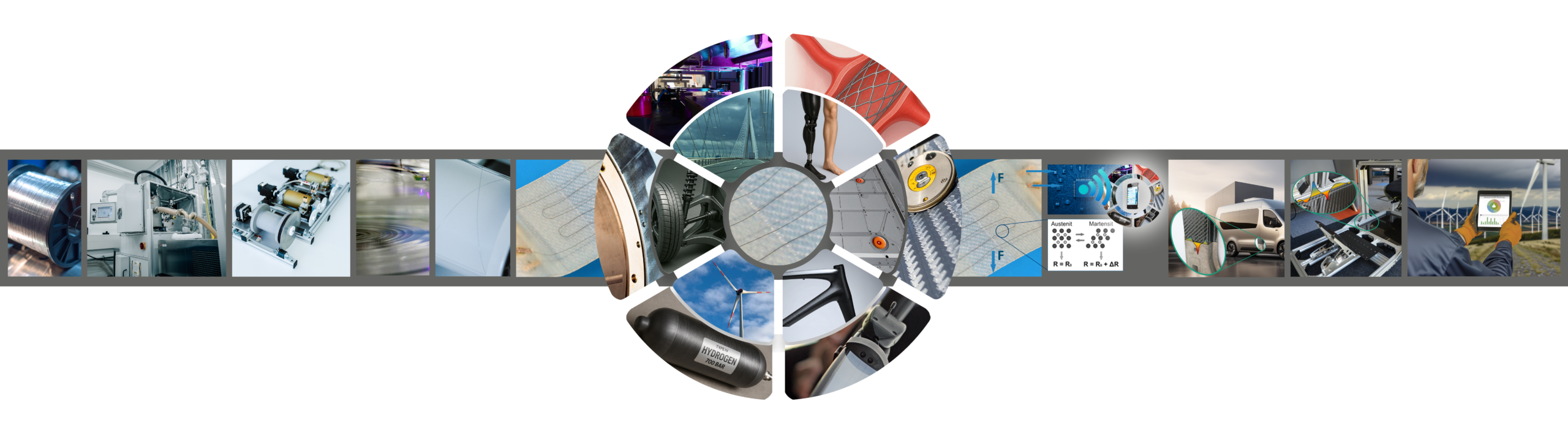
- Automotive, wind power, mechanical engineering, medical technology, sports equipment
- Lightweight construction with fiber-plastic composites
- Membranes, control elements, prosthetics, pressure vessels
- Textile/wood/concrete strain sensing
- Example: Rotor blade sensor (8×10 mm, 120 Ω, k = 5.4)
Development & Services
We support you with:
- Design & optimization of application-specific sensors
- Automation & manufacturing processes
- Integration, contacting, amplifier modules, miniaturization
- Calibration, delamination detection & application transfer

Further information is available here.